

Photography by Daniel Lopez Perez


Photography business plans don’t need to be long and technical.
What most photographers need is a simple, clear plan that helps them make better decisions.
Something that includes:
- what you shoot
- who you serve
- how you price your work
- how you consistently get clients
- what the business needs financially to work
That’s what this guide will help you make.
Not a 40-page document you write once and forget.
But a clear photography business plan you can actually use in your work.
Related Photography Business Guides
A business plan helps you make better decisions before you get too deep into the work. These guides will help you start from where you are, build the business step by step, price your work, and handle the legal setup once you’re ready.
| Next step | Guide |
|---|---|
| Start with no photography experience | How to Start a Photography Business With No Experience |
| Start a photography business | How to Start a Photography Business |
| Price your photography work | How to Price Wedding Photography |
| Set up your business legally | How to Start a Photography Business Legally |
What Is a Photography Business Plan, Really?
A photography business plan isn’t just a formal document. It’s not something you make once, put in a drawer, and never look at again.
To really be useful, a photography business plan should be something you reference often—and revisit as your business changes.
In practice, a business plan is a way to think through how your business actually works before you get too deep into the day-to-day demands of running it.
At its core, it answers a few practical questions:
- What kind of photography do you offer?
- Who do you serve?
- How do you make money?
- How do clients find you?
- What does it take to run the business from inquiry to delivery?
If those answers are vague, the business can feels vague, too.
Pricing gets fuzzy. Marketing gets inconsistent.
You end up saying yes to work you don’t really want, or building a business that doesn’t create the income you actually need.
When these answers are clear, everything gets easier.
You can make better decisions about your niche, your pricing, your website, your marketing, your client experience, and even your gear purchases.

Why Photographers Benefit From Having a Business Plan
A lot of photographers resist the idea of writing a business plan because it sounds corporate or like unnecessary busy work.
I get that.
I didn’t have a business plan for the first several years of my wedding photography work, either.
And for a while, that was fine. I was working, learning, and getting experience.
But eventually I realized I needed to get more intentional about how the business actually worked—how I was getting clients, how I was pricing my work, and what I was building toward.
So I stepped back and created a plan.
Since then, it’s become something I revisit periodically when I need to refocus, rethink my goals, or make changes in the business.
That shift—from reacting to being intentional—made a big difference.
A business plan creates that pause on purpose instead of waiting until you hit a stressful moment and realize something needs to change.
What a Business Plan Helps You Clarify
A good photography business plan is less about writing and more about decision-making.
It helps you clarify:
- what you are actually selling
- who your ideal client is
- how you position yourself in your market
- what your pricing needs to support
- how you plan to get consistent inquiries and bookings
- what kind of business you are realistically trying to build
Most photographers do not struggle because they lack talent.
They struggle because these pieces are unclear or disconnected.
For example, someone may want premium clients but still be marketing like a budget photographer.
Or they may want a sustainable calendar but have pricing that only works if they shoot constantly.
A business plan helps surface those mismatches early.
Why Most Photographers Don’t Need a 40-Page Document
Traditional business plans were designed for lenders, investors, and larger companies.
Most photography businesses are not in that category. And that’s why you don’t need a super-long business plan.
If you’re running a solo or small service-based business, you don’t need a formal document with every classic business plan section fully developed.
In many cases, a one- to three-page plan is enough.
This is especially true if:
- you work alone
- you’re not raising money
- you’re not hiring a team yet
- you want a plan to guide your own decisions, not impress someone else
The goal is not to write the most complete business plan possible.
It’s to write one that helps you run the business more clearly.

Lean vs. Formal: Which Kind of Photography Business Plan Do You Need?
Before you start writing anything, it helps to decide what kind of plan you actually need.
This is where a lot of photographers get stuck.
They assume “business plan” means a formal, highly structured document, and then either overcomplicate the process or avoid it completely.
In reality, there are two very different versions of a business plan.
One is lean and practical.
The other is more formal and detailed.
Knowing which one you need can save you a lot of wasted effort.
When a Lean Photography Business Plan Is Enough
A lean business plan is a shorter version built around the decisions that actually drive your business.
It includes things like:
- what you offer
- who you serve
- how you price your work
- how clients find you
- what your revenue goals look like
- how the business runs day to day
A lean plan is the right fit if you’re:
- starting a photography business
- working as a freelancer
- running a solo or small photography operation
- not seeking outside funding
- trying to build clarity more than formality
For most photographers, this is the right place to start.
A lean plan gives you enough structure to think clearly without forcing you to write sections you will never use.
When a Formal Photography Business Plan Makes Sense
A formal business plan makes more sense when the document needs to communicate your business to other people.
That may be the case if you’re:
- applying for a loan
- looking for investors or partners
- opening a larger studio with major overhead
- planning a substantial expansion
- building a team and formalizing roles
In those cases, your plan may need more detail around market analysis, operations, projections, organizational structure, and risk.
A lean plan is often the best starting point because it helps you figure out the business model first.
Then, if you need to expand it into a more formal document later, you already have the core logic in place.
A Simple Way To Choose
If your photography business is small, service-based, and owner-operated, start with a lean plan.
If the business needs external validation, outside capital, or a more formal operational structure, you may need to build something more detailed.
Most photographers should start with the lean plan.
You can always make the plan bigger later.
When You Probably Don’t Need a Business Plan
There are cases where you probably don’t need a full business plan at all.
If you’re:
- just testing the waters
- freelancing here and there with no plan to build further
- casually building a portfolio while keeping photography as a hobby or side activity
- not yet trying to create consistent income from photography
Then a full plan may be unnecessary.
But even then, it’s still worth spending a little time thinking through things like:
- how much you want to charge
- what kind of work you actually want
- what your first few lead sources might be
- what income would make the work feel worthwhile
You may not need a full business plan.
But some level of intentional thinking is always helpful, and usually helps you make more money in the long run.
What to Include in a Lean Photography Business Plan
A lean photography business plan just needs to cover the key parts of how your business works: what you sell, to whom, for how much, through which channels, and with what funding (if any) behind it.
Here’s an overview:
| Section | What You’re Clarifying | Why It Matters |
|---|---|---|
| Business concept and niche | What kind of photography business you are building | Keeps the rest of the plan from becoming generic |
| Target client and positioning | Who the business is for and why they would choose you | Shapes pricing, messaging, and marketing |
| Services and offers | What you actually sell and how it is packaged | Turns “I’m a photographer” into a real business model |
| Pricing and revenue goals | What you charge and what the numbers need to look like | Shows whether the business works on paper |
| Marketing plan | How clients will find you | Keeps lead generation from being vague or reactive |
| Workflow and operations | How the business runs from inquiry to delivery | Improves consistency and client experience |
| Financial plan | Revenue, expenses, and sustainability | Connects the plan to real business pressure |
| Goals and next steps | What happens next | Turns the plan into action |
This table is just the structure.
What matters is how you think through each part.
Let’s do that now.
1. Your Business Concept And Niche
Start by defining what kind of photography business you are building.
This is the foundation for everything else.
You don’t need a polished mission statement here, just a clear explanation of what you do and what kind of work you want the business to be known for.
That may include:
- your niche, such as weddings, portraits, branding, real estate, or commercial work
- the kind of client you want to serve
- the type of result or experience you want to provide
Be as clear as possible. If your concept and niche are fuzzy, the rest of the plan gets fuzzy, too.
2. Your Target Client And Positioning
Once you know what kind of work you want to do, the next question is who you do it for.
That is, who’s your target client?
A photography business plan works much better when it’s built around a specific type of client, not a generic idea of “anyone who needs photos.”
This section should help you clarify:
- who your ideal client is
- what they need help with
- what matters most to them when hiring a photographer
- why they would choose you over someone else
This is where your positioning starts to take shape.
A family photographer, a luxury wedding photographer, and a commercial product photographer may all be running photography businesses, but their clients, offers, pricing, and marketing will look completely different.
Your plan should reflect that.
3. Your Services And Offers
Many photographers describe themselves by style or genre, but not by offer.
That’s a problem, because a business runs on offers.
This section should spell out:
- your core services
- what is included in them
- whether you sell fixed packages, custom quotes, retainers, prints, albums, licensing, or add-ons
- how people actually buy from you
This doesn’t need to be overly detailed.
But it should be clear enough that someone reading the plan could understand how the business will make money.
It’s also a good place to think more strategically.
How you package your services can change the economics of your business.
A photographer might choose:
- lower entry pricing with clear upsells
- fewer, simpler packages to reduce friction
- a premium pricing structure to support a higher-end brand position
This is worth spending time on.

4. Your Pricing And Revenue Goals
This is one of the most important sections in the entire plan.
A lot of photography businesses run into trouble because the owner has creative goals and marketing ideas, but no clear revenue model.
At a minimum, this section should answer:
- what you charge
- how many bookings you want each month or year
- what revenue that would produce
- whether that number realistically supports your goals
This is also where pricing and your work capacity need to connect.
If your prices are low, you may need a high volume of shoots to make the business work.
If your prices are higher, you may need stronger positioning, a better client experience, or more targeted marketing to support them.
The goal isn’t to predict the future perfectly.
It’s to do your best to make projections, so the business model at least makes sense on paper. You can always come back and update it later.
5. Your Marketing Plan
A photography business plan should include a basic plan for how people will find you.
This doesn’t need to be a giant marketing strategy document.
It just needs to identify the handful of channels you actually plan to use.
That might include:
- SEO
- Your Google Business Profile
- referrals
- venue or vendor relationships
- email marketing
- paid ads
- local networking
You don’t need to do everything. Just choose a few approaches you can maintain consistently, that you think will actually work.
For example, a wedding photographer might build a focused plan around vendor relationships, Instagram visibility, local SEO for key search terms, and a steady review-and-referral habit with past clients.
That’s a real marketing plan.
A huge list of ideas you never execute isn’t.
6. Your Workflow And Operations
This is the part many photographers leave out, even though it has a big impact on both the client experience and profitability.
Think through the operational side of the business:
- how inquiries come in
- how clients book
- how contracts and invoices are handled
- how you prepare for shoots
- how editing and delivery happen
- how you follow up after the job
You don’t need to document every tiny step.
But you do want a basic understanding of how the business functions from inquiry to final delivery.
That helps you spot friction points and inconsistencies.
It also helps you build a business that feels more professional and repeatable.
7. Your Financial Plan
For a lean plan, the financial section doesn’t need to be complex.
It just needs to be real.
This section should usually include estimates for:
- expected revenue
- basic recurring expenses
- major one-time or seasonal costs
- minimum income the business needs to generate
You can also include simple targets like:
- monthly revenue goals
- average booking value
- quarterly booking goals
- profit targets
One useful exercise here is to look around your market.
See who shows up when you search for photographers in your area.
Look at what they seem to offer, how they position themselves, and, when possible, how they price their work.
That kind of research can help you estimate where the opportunity is and what your business might realistically need to do in order to compete or stand apart.
8. Your Goals And Next Steps
A business plan shouldn’t end with abstract ideas.
It should lead to action.
The final section of a lean plan can be short, but it should spell out what happens next.
For example:
- launch website by a specific date
- build a stronger portfolio in your target niche
- book the first five paid sessions
- raise your average booking value
- establish one or two reliable lead sources
This turns the plan from a document into a working tool.
Step-by-Step: How to Write a Photography Business Plan
We just covered the pieces of the plan.
Now, let’s build it.
Here’s the step-by-step:
Step 1. Start With Your Business Model, Not Your Wording
A lot of photographers get stuck because they think they need to begin by writing polished paragraphs.
Don’t get hung up here.
Just start with the underlying structure of the business:
- what you shoot
- who you serve
- what you sell
- how you price it
- how clients find you
Once those pieces are clear, the writing becomes a lot easier.
(And if those pieces aren’t clear, polished wording won’t solve the problem.)
Step 2. Work Out The Numbers Before You Polish The Language
One of the easiest ways to make a business plan feel useful is to work out the numbers early.
That includes things like:
- average booking value
- monthly revenue target
- estimated expenses
- number of bookings needed
This matters because numbers reveal whether the business model actually makes sense.
For example, if you want to earn a certain income but your current pricing would require an unrealistic number of shoots, it’s better to discover that now than six months down the road.
Step 3. Build The Lean Version First
Even if you think you may eventually need a longer, more formal business plan, it usually makes sense to build the lean version first.
This way, you’ll have a working plan you can use immediately.
Later, if you need a more formal document for a lender, a partner, or a studio expansion, you can expand.
This is usually faster and leads to a better result. Jump to the lean plan.
Step 4. Revisit the Plan Periodically
A photography business plan should not be something you write once and forget.
It should be something you revisit when:
- your niche changes
- your pricing changes
- you add or remove services
- your marketing strategy evolves
- your goals change
That is another reason a shorter plan often works better.
It is easier to revisit, easier to update, and more likely to stay useful.
Pro tip: Keep each section of your plan short, specific, and practical
Most photographers don’t need long sections. The key is to make each section specific.
For example, instead of saying “I will market on social media,” say which platform you will use, how it fits your business, and what role it plays in bringing in leads.
If a section feels vague, shorten it until it becomes concrete.
A Simple Photography Business Plan Example
Sometimes the easiest way to understand a business plan is to see what one actually looks like.
The example below is intentionally simple.
It’s meant to show how a lean photography business plan might look for a solo photographer.
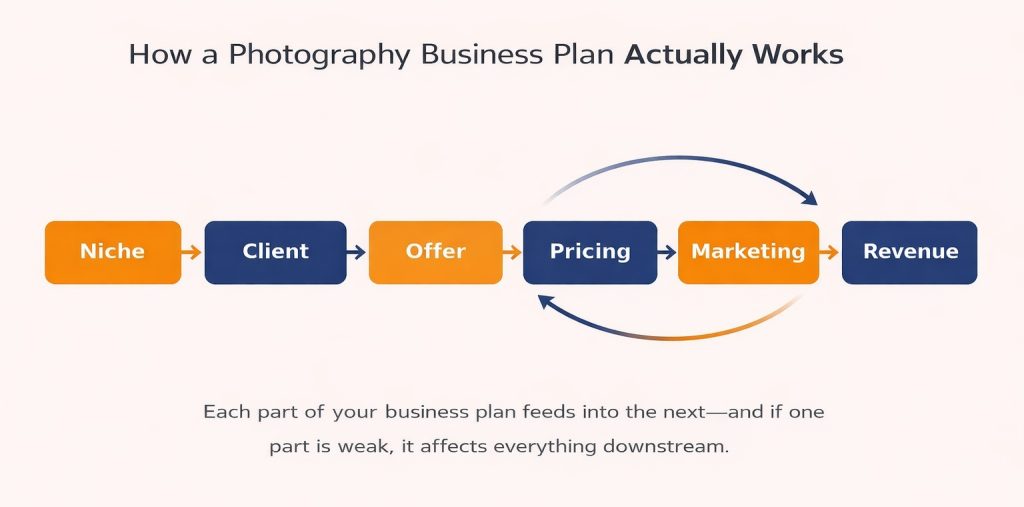
More importantly, it shows how the pieces connect.
Your niche affects your client type → Your client type affects your offers → Your offers affect your pricing → Your pricing affects how many bookings you need and how you need to market the business.
Example: Freelance Portrait Photographer
- Business concept: Solo portrait photographer offering family, maternity, and personal branding sessions in the local area.
- Target client: Families and small business owners who want natural, polished images without an overly high-pressure luxury experience.
- Offers: Portrait sessions, mini sessions, and personal branding packages.
- Pricing model: Fixed packages with optional add-ons for extra images and prints.
- Marketing plan: Local SEO, Instagram, referrals from past clients, and partnerships with related local businesses.
- Operations: Inquiry form, consultation by email or phone, online contract and invoice, shoot, edit, gallery delivery, follow-up for reviews and referrals.
- Financial goal: Book six to eight sessions per month at an average booking value that supports the target income.
- Next steps: Improve portfolio positioning, strengthen local website pages, and increase inquiries from the best-fit client type.
What This Example Is Meant To Show
The point of this example isn’t to give you language to copy word for word.
It’s to show that a photography business plan can be short, clear, and tailored to the kind of business you are actually building.
A usable plan is usually better than a perfect one.
If the logic holds together, the document does its job.
How This Changes For Different Types of Photography Businesses
The overall structure stays similar, but the details should change depending on the type of photography business you are building.
That matters because a plan only helps if it reflects the real shape of the business.
A freelance photography business is usually the simplest version.
In many cases, one person is doing everything:
- marketing
- sales
- shooting
- editing
- delivery
- admin work
Because of that, a freelance plan often needs to focus heavily on clear service offers, time capacity, pricing that supports solo work, and lead generation you can realistically maintain.
A studio photography business usually needs a little more structure.
That may be because you have a physical space, higher monthly overhead, staff or contractors, more standardized services, and a stronger need for predictable booking volume.
In that kind of business, the financial and operational sections often become more important.
Some photography businesses also need the plan to reflect a more specialized market.
A wedding photographer—like me—may need to think more carefully about annual booking targets, vendor relationships, collections, average booking value, and seasonal lead flow.
A real estate photographer may need a plan built around recurring clients, fast turnaround, and route efficiency.
A commercial photographer may need a plan built around custom quoting, licensing, and long-term client relationships.
The goal is fit.
Your business plan does not need to look like someone else’s.
It needs to reflect the business you are actually trying to run.
5 Common Mistakes Photographers Make When Writing a Business Plan
A photography business plan can be simple and still be really useful.
But there are a few mistakes that can make it feel generic, unrealistic, or disconnected from how the business actually works.
Here are the five most common mistakes I see photographers make when creating their business plans:
1. Making It Too Formal Too Early
One of the biggest mistakes photographers make is assuming the plan needs to sound official from the start.
That often leads to long sections filled with generic language and very little real clarity.
A better approach is to make the plan useful first.
If you ever need to make it more formal later, you can do that once the underlying ideas are clear.
2. Writing Around The Real Business Model
Sometimes photographers write a plan based on what sounds good instead of what the business actually does.
For example, the plan may say the business serves one type of client, while the portfolio, pricing, and marketing all point somewhere else.
Or it may list lots of services without making clear which ones are the real focus.
A strong plan reflects the actual business model:
- the work you most want to do
- the client you most want to serve
- the offers you most want to sell
- the lead sources you are most likely to rely on
If those things are disconnected, the plan stops being useful.
3. Guessing On Pricing And Financials
A business plan does not need perfect numbers.
But it does need honest ones.
Many photographers either skip the numbers completely or plug in numbers they have not really thought through.
That creates problems later.
Even rough estimates are better than avoiding the math.
4. Making The Marketing Section Too Broad
It is easy to write down every marketing idea you have ever heard of.
But a long list is not the same thing as a plan.
For most photographers, it is better to focus on a few lead sources that actually fit the business and can be maintained consistently.
A narrow marketing plan is usually more valuable than an ambitious one you will not follow.
5. Never Updating The Plan
A business plan should evolve as the business evolves.
If your niche changes, your pricing shifts, or your goals become more specific, the plan should reflect that.
Otherwise, it becomes a snapshot of an earlier version of the business.
That is one reason lean plans work so well.
A shorter document is much easier to revisit and revise.

What To Do After You Finish Your Photography Business Plan
Making the plan is a great start. And if you’ve made a plan—congrats!
That’s a great move for your business, and your future photography income.
But the real value of a photography business plan comes from what happens next—using the plan to help you make better decisions as your business grows and matures.
Here’s how to do that.
Turn The Plan into Weekly Decisions
Once your plan is written, use it to guide what you actually work on.
For example, it can help you decide:
- which offers to promote
- which client type to prioritize
- which marketing channels deserve your attention
- whether your pricing supports your goals
- what operational problem needs to be solved next
Without the connection to real decisions, the plan stays theoretical.
But using it to drive your decision-making make the plan actually useful. And worth the time you took to build it.
Review It Every Quarter
Your business plan shouldn’t stay frozen.
A simple quarterly review is often enough to keep it relevant.
You can ask:
- Is this still the kind of work I want to do?
- Am I attracting the right clients?
- Are my prices and revenue targets still realistic?
- Which marketing channels are actually working?
- What needs to change next?
That kind of review helps the business stay intentional instead of drifting.
Use Other Systems To Support The Plan
A business plan helps you define the direction of the business.
But it works best when it connects to other tools and systems.
Depending on where you are in the process, that might include:
- your legal setup and business structure decisions
- your pricing framework
- your marketing or SEO plan
- your bookkeeping and financial tracking habits
The business plan gives those systems context.
It helps make sure the day-to-day work is actually moving the business in the direction you want it to go.
A Good Photography Business Plan Should Help You Run the Business
A good plan doesn’t just describe your photography business.
It helps you run it.
If your plan is clear enough to help you make better decisions, it’s doing its job.
It doesn’t need to be long.
It doesn’t need to sound corporate.
It just needs to help you manage the business with more clarity, more intention, and a stronger sense of what actually has to happen next.
Photography Business Plan FAQs
Here are some of the most commonly-asked questions around how to create a business plan for photographers.
Do photographers actually need a business plan?
Not always. But most photographers benefit from having one. If you’re trying to build consistent income, set pricing intentionally, or grow your business, even a simple plan can make a big difference. It helps you connect the pieces instead of figuring everything out reactively.
How long should a photography business plan be?
For most photographers, one to three pages is enough. The goal is clarity, not length. If you don’t see yourself revisiting your plan because it’s long and complicated, it’s too long.
What’s the difference between a business plan and a pricing strategy?
Your pricing strategy is one part of your business plan. The plan connects pricing to your niche, your client, your marketing, and your income goals so everything works together.
Do I need a formal business plan to start a photography business?
No. Most photographers should start with a lean version focused on how the business actually works. A formal plan only becomes necessary if you’re seeking funding, building a larger operation, or needing to present the business to others.
Should I use a photography business plan template?
Templates can be helpful as a starting point, but they often include sections you don’t need. It’s usually better to build a plan around your actual business model than to fill in a generic document.
When should I update my business plan?
Any time your business changes in a meaningful way—your niche, pricing, services, or goals. A quick quarterly review is usually enough to keep it relevant.
What’s the biggest mistake photographers make with business plans?
Treating it like a document instead of a tool. A good plan helps you make decisions. If it just sits untouched, it’s not doing its job.


 Español