

Photography by Daniel Lopez Perez


Great wedding photography isn’t just about capturing the moment.
It’s also about showing the moment in a way that feels bigger than what people experienced in real time.
That’s where drone wedding shots can help.
If you know how to use them, drones can add scale, context, and perspective you simply cannot get from the ground.
But not every aerial photo is worth taking—and not every moment benefits from putting a drone in the air.
In this guide, I’ll walk through the drone wedding shots that are actually worth trying, based on real-world use at weddings.
Related Drone Wedding Photography Resources
Knowing which drone shots to try is only part of the process. These guides will help you improve your aerial compositions, choose a drone for wedding work, and decide how drone coverage fits into your wedding photography packages.
| If you want to… | Start here |
|---|---|
| Learn the bigger picture of using drones at weddings | Drone Wedding Photography |
| Improve your aerial wedding compositions | Composition for Drone Wedding Photos |
| Choose a drone for wedding photography | Best Drone for Wedding Photography |
| Build drone coverage into your wedding packages | How to Create a Drone Wedding Package |
What Makes A Drone Wedding Shot Worth Taking?
A good drone wedding shot is not just a regular wedding photo from higher up.
It earns its place by doing something the ground cannot do as well. Usually that means one of four things:
- showing scale
- adding environmental context
- revealing shape or symmetry
- turning an ordinary-looking scene into something much stronger from above
That’s the filter I would use before putting the drone in the air.
If the aerial shot only changes the angle, it may not be worth the time. If it reveals something genuinely different, it probably is.
A Good Drone Shot Does Something The Ground Cannot
This is the simplest way to think about it: a ground camera is usually better at emotion, facial expression, and intimacy, while a drone is better at context, scale, spacing, and the relationship between people and place.
That means the best drone wedding shots aren’t trying to compete with your ground coverage. Instead, they’re doing a different job.
A strong venue overview, a couple portrait surrounded by landscape, or a large group arranged in a clean shape can all work because the aerial angle adds information the ground cannot easily show.
[Looking for a good wedding drone? Check out our list of the best 4 drones for wedding photography.]
Keep reading for the top five drone wedding shots to take.
1. Venue Drone Shots
If I had to choose one drone wedding shot category that is the easiest to justify, easiest to execute, and most consistently useful, it would be the venue.

Wedding photos are about memory, and the venue is part of that memory.
A good venue drone shot gives the couple something they usually cannot see clearly on the day itself: the full shape of the place where everything happened.
Why Venue Shots Work So Well
One of the reasons I like venue shots so much is that they give you time to explore.
You can put the drone up, move around, and look for the angle that actually makes the place feel memorable instead of settling for the first overhead view you find.
Plus, you’re working with a subject that is patient and predictable.
And sometimes these shots feel even more powerful than a ground-based establishing image because the drone shows not just the building or ceremony site, but also the surrounding landscape, layout, and atmosphere.
If the location is beautiful, unusual, or central to why the couple chose it, this shot usually has a real job to do.
Best Time To Get Them
The easiest time to get venue drone shots is usually before guests arrive.
That gives you more freedom to explore angles, look for clean compositions, and work without worrying that you are missing stronger ground moments. Arriving a little early often makes all the difference here.
A short early window can let you:
- capture the ceremony site before it fills up
- show the reception setup while it still looks clean and intentional
- get an establishing image that helps anchor the rest of the gallery
What To Look For From Above
Don’t assume the best venue shot is always the highest one.
Sometimes the stronger image comes from a moderate height where you can still feel the shape of the venue and the relationship to its surroundings without turning everything into tiny abstract forms.
Look for:
- clean geometry in the building or ceremony layout
- a strong relationship between the venue and the surrounding landscape
- leading lines like pathways, courtyards, docks, or roads
- a framing angle that gives the scene scale without making it feel distant.
2. Landscape And Cityscape Drone Shots
Sometimes the most important part of the wedding scene is not the venue itself. It’s everything around it.
That’s especially true in places where the landscape or city is part of why the wedding feels memorable in the first place.
In those cases, a drone can help you show not just where the wedding happened, but what made the place feel distinct.

When The Surroundings Matter More Than The Building
A venue can be beautiful, but still not be the most visually important part of the scene.
At beach weddings, the shoreline and water may matter more than the structure itself.
In mountain settings, the surrounding terrain may be doing most of the visual work.
In a city, rooftops, streets, and skyline context can give the wedding a stronger sense of place than the building alone.
This is why I would think about landscape and cityscape shots as their own category instead of treating them like a small variation on venue shots.
The job here is not just to document the property. It’s to show the world the wedding sits inside.

How To Keep The Shot Connected To The Wedding
One easy trap with landscape drone shots is making an image that is beautiful, but could belong to any travel gallery.
That’s not always a problem, but for most wedding work you still want some connection to the actual event.
That could come from:
- including the venue in the frame as an anchor
- showing the ceremony setup in context
- including the couple or guests as small but visible elements
- using the image as part of a sequence that clearly belongs to the wedding day
The goal is not just to prove the location was scenic. It is to make the setting feel like part of the wedding story.
Why These Shots Can Be So Strong In Destination Weddings
This is one place where destination weddings really shine.
When a couple chooses a place because of its geography, atmosphere, or cultural feel, landscape and cityscape drone shots can become some of the most memorable images in the gallery.
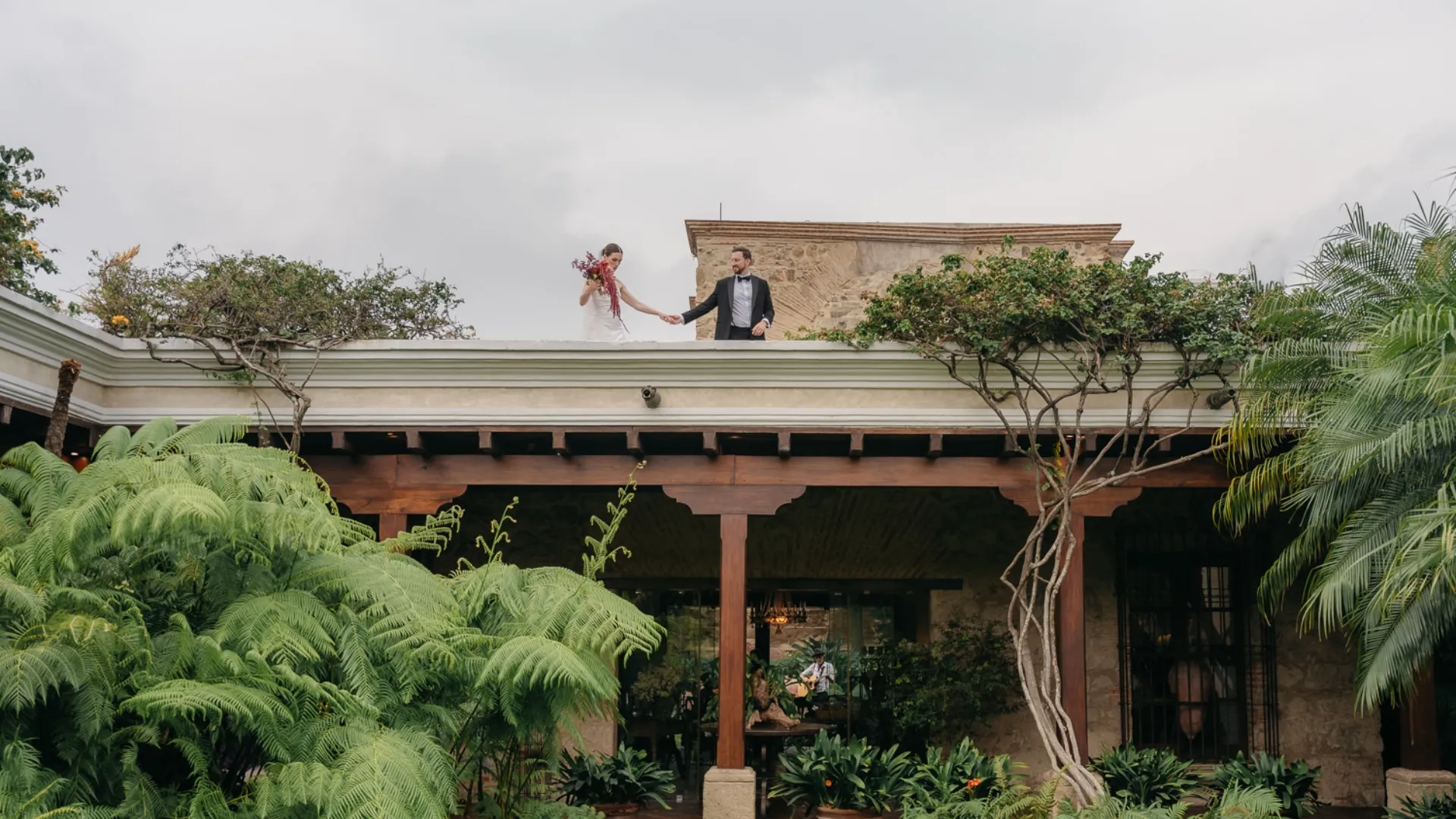
That’s part of why I think my wedding photography work in places like Antigua and Lake Atitlán translates so well to aerial photography.
In a location with strong architecture, history, or natural drama, the drone is not inventing interest. It is revealing it. If the place already has a strong visual identity, a drone can help make that visible in a way the ground often cannot.
3. Drone Shots Of The Couple
If venue and landscape shots are often the easiest aerial wins, couple shots are often the most striking.
A strong drone photo of the couple can feel intimate and expansive at the same time.
You get the emotional center of the wedding, but you also get the scale and environment that make the image feel different from a standard portrait.
The trick is to keep the shot intentional.

Standing Shots of Couples Vs. Lying-Down Shots
These are usually the two main versions worth thinking about.
Standing shots often work best when the environment is doing a lot of the visual work. The couple becomes part of the scene, and the power of the image comes from how they sit inside the landscape, venue, or surrounding geometry.
Lying-down shots, on the other hand, feel more graphic and stylized.
They can work especially well when there is a strong surface underneath the couple or when you want the embrace itself to become the center of the frame.
Neither version is automatically better.
The question is what the ground below them looks like, what the mood of the image should be, and whether the setting is contributing enough to justify the aerial perspective.
How To Make The Couple Small Without Making Them Irrelevant
This is one of the easiest mistakes to make with drone couple portraits.
You go up too high, get excited about the location, and suddenly the couple stops feeling like the subject, and turn into tiny dots in a scenic frame.
Sometimes that can work, but usually you still want them to feel intentional and readable.
A better approach is to experiment with a few heights and framing distances so you can find the point where:
- the surroundings still feel important
- the couple still feels clearly placed and purposeful
- the image reads as a wedding portrait, not just a landscape with two people in it
The strongest frame is often not the highest one.
What Usually Makes These Shots Awkward
Couple drone shots usually go wrong for one of three reasons:
- the photographer did not think through the composition ahead of time
- the couple is left waiting too long while the drone setup happens
- the photographer asks for a pose that feels surprising or uncomfortable without preparing the couple for it
This is why communication and speed matter so much here.
If you want the couple lying down, tell them ahead of time.
If you already know the angle you want, get the drone up quickly and make the image without dragging the moment out.
The drone should make the shot feel special, not turn it into a technical delay.
4. Group Drone Shots
Group drone shots are one of the most underrated aerial options at a wedding.

These shots are easy to understand, usually fun for the people in them, and often much cleaner from above than photographers expect.
A drone lets you include more people without the same amount of reshuffling you might need from the ground, which is one reason they work so well.
Why Group Aerials Often Work Better Than Expected
A big group tends to simplify nicely from above.
Instead of fighting for depth, faces, and uneven spacing at eye level, you get a flatter, more graphic arrangement.
People are all oriented toward the same point, and the image can feel more unified.
That’s part of why these shots often land so well with couples and guests: they feel a different from the standard large-group photo without becoming weird or overly experimental.
Wedding Party Shapes And Guest Group Shots
You can use group drone shots in a few different ways.
The most obvious option is a large guest group, where everyone looks up and the drone captures the whole crowd cleanly.
But wedding-party-only versions can also work really well, especially when you can arrange people into a shape with strong spacing.
A few good options to consider:
- a full guest group gathered in one clear open area
- the wedding party arranged in a circle, line, or loose symmetrical pattern
- a smaller group positioned around the couple so the composition still has a clear center
The stronger the spacing, the better the shot usually reads.
5. Event-Moment Drone Shots
Some of the most tempting drone wedding shots happen during live moments, when people are moving, interacting, and creating a lot of natural energy. These can be great images.
They can also be the easiest ones to mishandle.
So I would think of this category as less reliable than venue, landscape, couple, or group shots—but still worth including because the right live-moment aerial can add something special to the gallery.

First Dance And Outdoor Reception Shots
These can be strong, but they depend heavily on the setting.
An outdoor first dance or open-air reception can look great from above, especially when the lighting, crowd shape, and surrounding environment all contribute to the frame.
But these are also the kinds of moments where it is easy to chase the idea of the shot harder than the shot deserves.
That’s why I would treat reception and first-dance aerials as selective opportunities.
They work best when:
- the reception is outdoors or visually open enough to read from above
- the scene has enough light or structure to hold together
- the drone can be used without pulling you away from stronger ground-based images
When those conditions are there, the result can feel cinematic. When they are not, it is usually better to keep the drone grounded.
Cocktail Hour Shots
Cocktail hour is often one of the best live moments for drone work.
You get movement, guest interaction, and more energy in the frame, but usually with less pressure than the ceremony or a tightly scheduled reception beat.
It’s also one of the easiest times to make an aerial image that shows both the people and the atmosphere of the venue at the same time.
That is why cocktail hour often produces some of the most useful live-moment drone shots:
- guests mingling in a scenic space
- the venue with people finally in it
- a wider ambiance shot that helps the gallery feel more complete
If I were choosing one live part of the day to prioritize for drone use, cocktail hour would be high on the list.

How To Make Drone Wedding Shots More Interesting
Once you know which drone wedding shots are worth trying, the next question is how to make them stronger. Usually it comes down to noticing what the drone reveals that the ground does not.Use Shapes, Spacing, And Negative Space
One of the easiest ways to improve a drone shot is to stop thinking only about the subject and start thinking about the space around the subject. From above, spacing matters more. That applies to:- the distance between the couple and the edges of the frame
- the way guests are arranged in a group shot
- the shape of a ceremony layout or reception space
- the amount of negative space surrounding the main subject
Look For Scenes That Simplify From Above
Some places look more chaotic from the ground than they do from the air. A courtyard, dock, beach, garden path, rooftop, or line of chairs might feel ordinary at eye level and much stronger once the drone reveals the overall shape. The same goes for scenes where the people, objects, or architecture start to organize into a cleaner composition from above. If the aerial view makes the scene simpler, stronger, or easier to read, that is usually a good sign.Do Not Overwork The Idea
A lot of drone shots get weaker because the photographer stays in the air too long. You found the idea. You got the image. But instead of landing, you keep hovering, trying minor variations that do not really improve the shot. That can waste time, pull attention from better ground coverage, and turn a clean moment into a dragged-out one. Instead, I recommend moving briskly:- identify the idea fast
- test a few strong variations
- get the image
- land and move on
Drone Wedding Shots FAQ
Here are answers the questions I see come up a lot around drone wedding shots.
What Are The Best Drone Wedding Shots?
The best drone wedding shots are usually the ones that show something the ground cannot show as well. For most weddings, that often means:
- venue shots
- landscape or cityscape context shots
- couple portraits with strong surroundings
- group photos from above
- select cocktail hour or outdoor reception images
When Should You Take Drone Wedding Shots?
Usually when the timeline gives you a clean chance to get them without hurting stronger ground coverage.
In practice, that often means early venue coverage, couple portraits, cocktail hour, or another short window where the drone has a clear job to do.
Are Ceremony Drone Shots Worth It?
Sometimes, but they are usually not the strongest default. They can work when the setting is unusually strong and the shot can be made quickly without distracting from the moment. But for most weddings, ceremony drone shots are more of a selective opportunity than a core category.
How Many Drone Shots Should Be In A Wedding Gallery?
Usually not many. For most weddings, a few strong drone images are enough. The value usually comes from range and perspective, not from turning the drone into a major percentage of the gallery.

 Español