

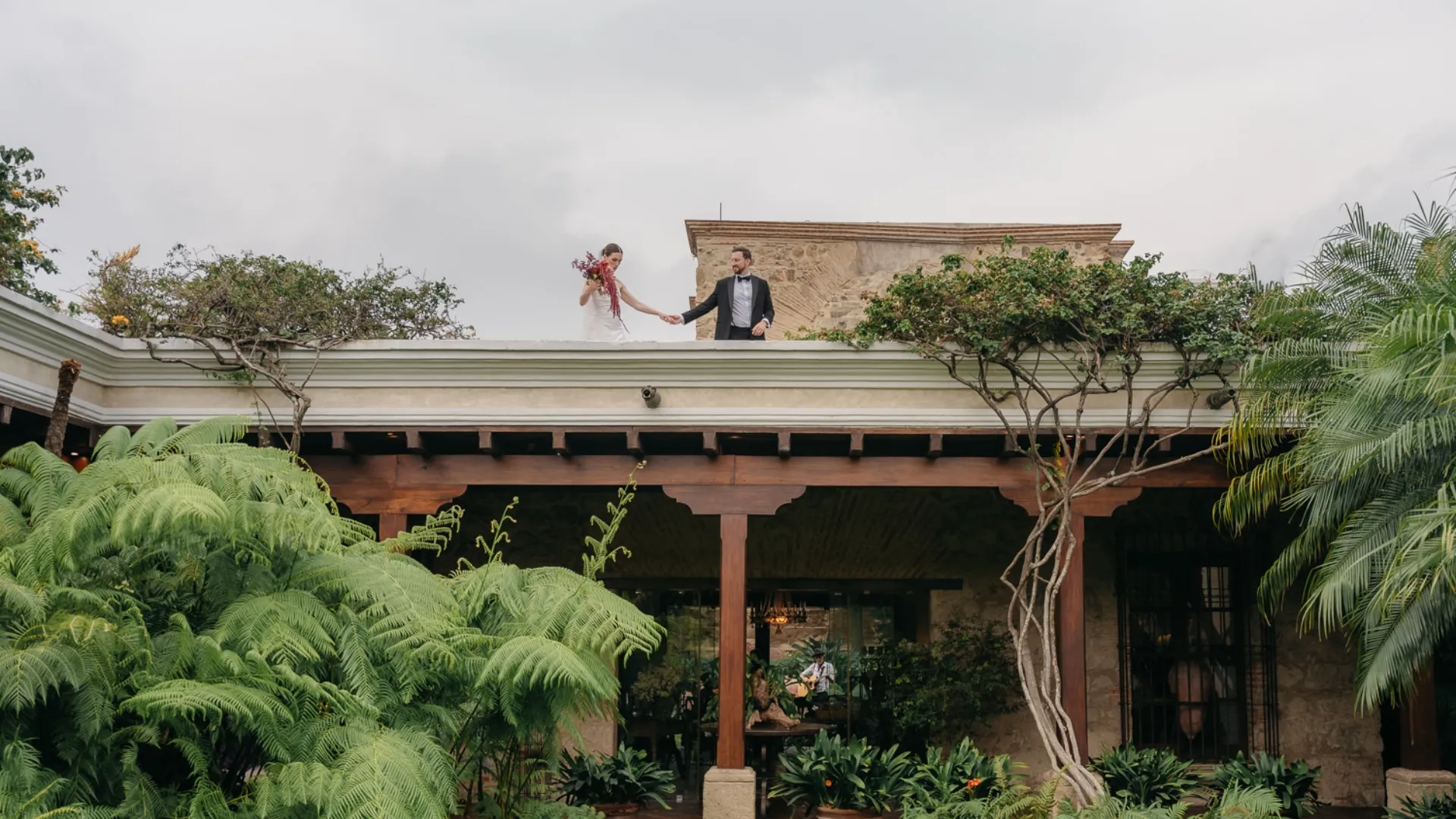
Original photography by Daniel Lopez Perez


A drone gives you a completely different perspective on a wedding.
But getting higher in the air doesn’t automatically make the photo more interesting.
If your drone wedding photos feel flat or disappointing, composition is often the problem.
You still need to think about shape, scale, spacing, lines, and where the viewer’s eye goes. The difference is that you’re working from an aerial perspective, where landscapes, buildings, and groups of people can become part of the composition in completely new ways.
In this guide, I’ll share practical composition tips specifically for drone wedding photography.
Related Drone Wedding Photography Resources
Strong composition is one part of creating better aerial wedding photos. These guides will help you understand the bigger picture of using drones at weddings, plan stronger drone shots, and choose a drone that fits wedding work.
| If you want to… | Start here |
|---|---|
| Understand the bigger picture of using drones at weddings | Drone Wedding Photography |
| Plan stronger aerial wedding shots | Drone Wedding Shots |
| Choose a drone for wedding photography | Best Drone for Wedding Photography |
Finding the Balance: Improving Composition in Your Drone Photography
The rules of composition for using a camera on a drone are pretty much the same as for using a camera on the ground.
But there can be some tricky differences, and it’s hard to know them without some experience flying.
To fast track your knowledge, this article contains everything I’ve learned about composition as a wedding photographer who uses drones in my work.
While it’s true that composition in photography follows well-established principles and rules, getting the right shot often comes with a mystical element—one that defies all rules.
You can follow all the rules and your photo may appear lifeless. Or you can break them and find that you’ve taken one of the best photos of your life.
“Composition tips should be used as a source of inspiration rather than a list of concrete rules. The most important thing is to get out there and try finding new creative inspiration.”
– DJI
So how do you get better?
The key is to experiment. Try new things on, and don’t get too hung up on doing things “the right way.”
Keep moving, and keep things light and fresh, always trying new things but in a structured manner. This way you’ll find what works for you, and discover new ways to get drone photos that resonate with your couples.
While experimenting, keep basic composition guidelines in mind. And when you break them, do it on purpose.
Here are eight tips to help you improve the composition and framing in your drone wedding photos. Play with these at your next wedding shoot, and tell me what you think in the comments.
[I’ve been shooting weddings for almost 15 years—Here are my top 10 tips for wedding photographers]
1. Move Your Drone Around While Shooting
The other way to say this is: Don’t stay in one place.
The same principle applies for traditional photography.
It’s always good to get closer, then further away, then turn around, constantly moving to find new angles you might not notice if you stay still.
This general tip for improving composition applies quite well to the specific case of drone wedding photography.
When you’re doing an aerial shoot at a wedding, make sure you take a quick tour of the area with your drone once you put it in the air, turning the drone around, tilting the camera gimbal up and down.
The key here is to be playful. Keep moving, looking with fresh eyes to see how changing your perspective through movement changes the shot.
Pro tip: Remember, a drone can move around in three dimensional space more freely than a person can on the ground. Use that freedom to find new angles and new ways to frame your shots, and make sure you don’t get stuck thinking that there are only a set number of ways you can use a drone to shoot a wedding.
2. Balance the Size of the Couple in the Photo
If the couple you are photographing looks way too small—which can happen easily when shooting subjects from the air—the “wow” effect will be lost.
[Looking for a good wedding drone? Check out our list of the best 4 drones for wedding photography.]
But you probably don’t want them to look too big, either, and take up the entire frame.
You have to balance the size of the couple in your frame with how much and what parts of the surrounding landscape you want to include in the shot. You can either get more of the surroundings or more of the couple, but not both—and finding the right balance for each shot is key.

Pro tip: Avoid taking a wider shot with the plan of cropping it in post.
Most drone photos have a lower pixel count than photos taken with traditional cameras, so trying to fix the framing in post means you’ll be losing quality in your shots. Instead, play with the framing and try to get it right, or close to it, in your original drone shot.
3. A Trick for Taking Vertical/Portrait Photos with Any Drone
Sometimes you can’t fly your drone further away, and only a vertical photo can capture all the elements you want in a single photo.
Right now, only three consumer drones have been made that let you rotate the camera to take vertical photos: the DJI Mavic Pro 1, the DJI Mavic Mini 3 Pro, and the Autel EVO Lite.
But there is a simple trick to taking vertical photos with any drones.
Here’s how to do it:
- Take two or three overlapping photos, tilting your camera up and down as you shoot them.
- Then stitch these photos together like a panorama in Lightroom, Photoshop, or your preferred editing software.
That’s it. Now you can make a vertical drone shot, even though you couldn’t get the drone’s gimbal to shoot vertically.
Pro tip: Make sure you don’t tilt the gimbal all the way down and up. Doing this will cause distortion, which can make your photos look a bit unrealistic.
4. Use Light and Shadows to Create Interesting Composition
Shoot at sunset or sunrise to get exaggerated contrasts between light and shadow.
When the sun is low—at either sunset or sunrise—it can produce shadows of your couples or other subjects for your drone photos, making them appear incredible from the air.
These contrasts create extremely unique pictures that will captivate anyone who looks at your photos. Not to mention, they’ll make your couples extremely happy with your work.
5. Find Patterns and Shapes as You Elevate Your Drone
When you fly your drone and start taking it up, your entire visual experience changes pretty fast.
As you look down from the air, try to identify patterns that will amplify your shots.
Patterns could come in the form of shapes, sizes, or colors. Patterns in any of these elements, or a combination of them, can help bring your drone photo composition up to a new level of quality.

As you get better at flying, you’ll start noticing that certain elements that don’t seem to have interesting shapes or patterns from the ground take a completely different form when viewed from the air.
Trees, gardens, fountains, or clusters of buildings can all be rich opportunities for finding patterns and shapes to enrich the composition of your shots.
As you fly, make sure to move your drone around (remember the first tip!) to see where the patterns start and stop.
Analyze these patterns until you find the best spot to place your couple to achieve balance in the composition and weight of the photo, making it even more interesting.
6. Get Closer, Go Slower
As drone pilots we all get excited to be able to fly our drone high and get an aerial and expansive view of places.
But sometimes we need to slow down in order to see where the best shots are, instead of speeding straight up into the sky.
You might find a great aerial shot not too far in the air, depending on the other compositional elements. Another way to think about this tip is to think about exactly where you’d love to be standing to take a photo, and then use your drone to get right to that spot—even if it’s not super high in the air.
On a related note, you can also use a drone to get closer to your couple to show more detail on their faces while still photographing them from an interesting point of view.
7. Where Do You Place the Couple?
OK—you’ve found the perfect framing for your drone wedding photo.
Now comes a key decision: Where do I place the couple?
This decision can be guided by some of the general rules of composition, like the rule of thirds, symmetry, leading lines, rule of space, balance, and so on. (See our guide to composition in photography for more information on these rules.)

Pro tip: Include the couple in the decision.
In many cases, I’ll fly my drone with a few different framing options I have in mind, take some sample shots, and then show them to the couple to see how they react. They can then choose the framing they like best. Co-creating with the couple is a great way to make sure they’re getting what they want—it’s always something we encourage!
8. Lying Down or Standing?
This decision can be influenced by a couple of factors:
- Is your couple open to lying down? They’ll potentially get dirty, so not all couples will want to do this, especially on their wedding day.
- What is the framing you have in mind?
When thinking about whether the couple should be standing or lying, think about whether you want the drone’s camera to be pointing straight down or at an angle.

I personally love drone photos where the couple is lying down and the camera is pointing down at them, with the gimbal pointed 90 degrees down.
But sometimes getting the couple to lie down is a big ask if the terrain is dirty, the timing isn’t right (i.e., we’re shooting photos before the ceremony or first dance), or if it just doesn’t go with the couples’ personality.
Also, sometimes there are many possibilities for taking photos at an angle from up in the air that you could never take from the ground.
So just scout, move around, and keep your eyes open for the best outcome in each situation.

 Español